Research:In the field of political science, understanding how states choose to distribute public goods and services is crucial for comprehending state-building processes, ethnic and racial politics, democracy, and broader societal outcomes. My research focuses broadly on the provision of public goods, specifically examining the distribution of security in Latin America. I am particularly interested in investigating the dynamics of state-building and the consequences of state absenteeism in areas where public goods provision is lacking. Ultimately, my research seeks to shed light on the intricate interplay between state presence, ethnic and racial minority communities, and the emergence of alternative security practices such as vigilantism.
State-Building and Minority Politics: Understanding state-building processes is essential for comprehending the dynamics of power, governance, and the construction of democratic institutions. Through my research, I aim to contribute to the scholarship on state-building in the Latin American region. By examining the allocation of public goods and services, specifically security provision, I seek to shed light on the complex interactions between the state and ethnic and racial minority communities. My research aims to deepen our understanding as scholars of how state-building initiatives impact minority politics, addressing questions of representation, power dynamics, and the inclusion or exclusion of marginalized groups. State Absenteeism and Alternative Security Practices: A significant aspect of my research focuses on the concept of "state absenteeism," which occurs in areas where state presence and public goods provision, particularly in terms of security, are lacking. By analyzing these instances of state absenteeism, I aim to uncover the consequences and implications for affected communities. In the absence of state-provided security, communities may resort to alternative practices, such as community-based policing or vigilantism. Exploring these dynamics provide vital insights into the consequences of state absenteeism and its impact on local governance, social cohesion, and the rule of law. Broader Implications and Significance: Studying the provision of public goods, particularly security, and the consequences of state absenteeism holds significant implications for ethnic and racial politics, democracy, and broader societal outcomes. By elucidating the dynamics of state-building in the Latin American context, my research contributes to the understanding of power relations, governance structures, and the challenges faced by marginalized communities. It also has implications for policy interventions aimed at promoting inclusive state-building, reducing security disparities, and strengthening democratic institutions. Publications: "Shifting Positions: Part Positions and Political Manifestos in Costa Rica" -Latin American Politics and Society- This article analyzes how niche parties may utilize a strategy of policy shifting to garner additional voters. It leverages a unique opportunity in which a Costa Rican political party released two different versions of its party manifesto at different moments during a single election cycle. This rare opportunity uncovers how the party shifted from having a hard conservative stance on social issues, such as abortion, to moderating its stance and centering its focus on less contentious issues in a runoff election campaign. Understanding how a single political party may alter its strategy is important because it allows us to better gauge the effectiveness of shifting policy positions, especially for niche parties, for which a particular issue area is dominant. Moreover, this analysis opens additional avenues of research on political parties in the Latin American context, since research utilizing manifesto data in this context has been limited. Under Review “State Absenteeism: An Analysis of Vigilantism and Security Provision in Latin America” Vigilantism in Latin America is a complex political phenomenon with profound implications for societal dynamics. The latest surveys conducted by LAPOP have revealed a troubling reality: approximately one in five survey respondents in the LAC region reported experiencing crime within the last year. In response to these formidable challenges, citizens in the region have adopted diverse approaches to exert pressure on their governments, urging decisive action against crime and violence. However, these efforts have frequently been met with limited government response, leaving citizen concerns unaddressed. In light of perceived governmental neglect, a notable consequence has been the emergence of vigilantism as a means for individuals to take matters into their own hands, seeking to combat crime and safeguard their communities. This study aims to investigate the subnational factors that influence heightened levels of vigilantism and assess the adequacy of existing theories, such as Cultural and Path Dependency arguments, which do not fully address why vigilantism emerges in developing countries. I propose a novel theory of state-abseentism, specifically focusing on the presence of the state as measured by the number of police stations within a municipality, to explain subnational variation in vigilantism levels. To test the proposed theory, I utilize an original dataset, encompassing the locations and construction years of all police stations in each of the 331 municipalities in Guatemala. Employing logistic regression and negative binomial models, the analysis examines the relationship between the absence of the state (indicated by fewer police stations providing security) and the occurrence of vigilantism. Findings from empirical investigation reveal compelling results. When the state is more absent, the likelihood of vigilantism occurrence increases, along with a rise in the number of vigilante acts. This research provides valuable insights into the complexities of democratic governance, highlighting the need for robust state presence and responsiveness to citizen concerns in combatting vigilantism. “All Politics are National? Local and National Participation in Latin America” (with Erik Fay) This study examines the factors that influence political participation within 17 Latin American countries between 2008 and 2014. More specifically, this paper focuses primarily on what conditions drive political participation from the local to the national level in Latin America. As a secondary focus, this study explores whether there is a divergence in levels of political participation based on variation in the contextual environment, with an emphasis placed on decentralization within each country. The study of decentralization in the Latin American context is imperative since decentralization reforms that occurred in the region following the “third wave” trends of democratization were implemented to increase state legitimacy, democratic governance, and political participation. The literature surrounding questions regarding how decentralization influences political participation at the local and national level in Latin America have been scant. This paper seeks to fill in this important gap in the literature by tying individual-level theories of political participation at the local level to national-level, country-specific factors in order to better understand how citizens’ behavior responds to differences in their domestic environment such as variations in the levels of decentralization between countries. Empirical evidence from a logistic model suggests that individuals who participate locally are more likely to participate nationally and high levels of decentralization increase individual participation at the national level. Works in Progress “State Absenteeism in Guatemala: An Analysis of Unequal State Building and Uneven Security Provision for Indigenous Citizens” “State Absenteeism? An Analysis of Crime, Security, and Vigilantism” “Brazilian Bureaucratic Organizations: An Analysis of Networks and Job Satisfaction” (with Ames, B., Guedes-Neto, J., and McCoy, D.) 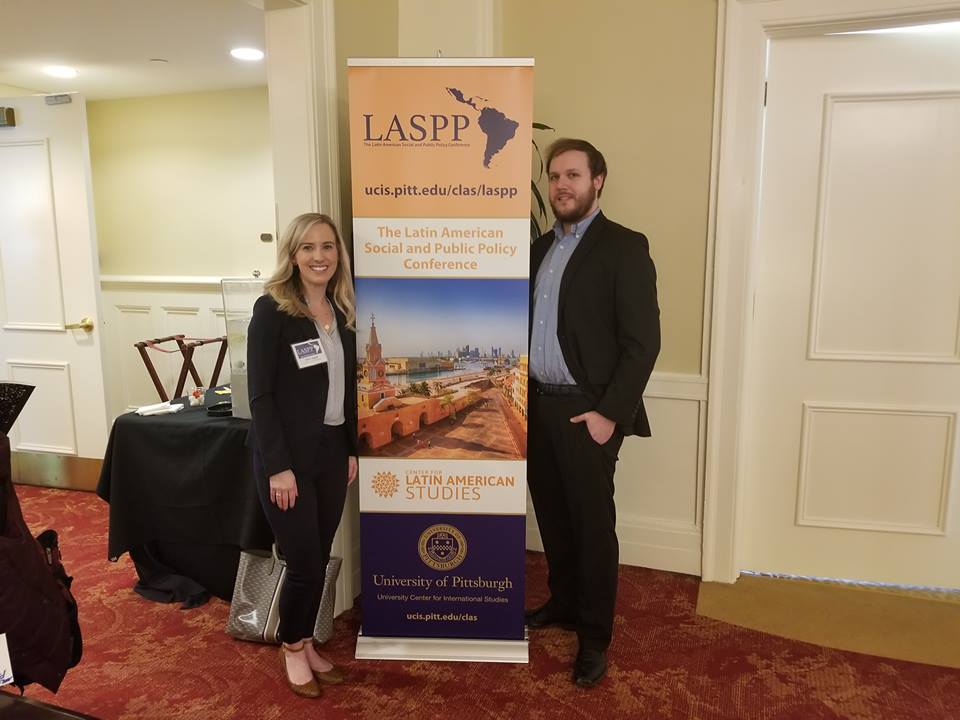
2019 Latin American Social and Public Policy Conference at University of Pittsburgh (with Erik Fay)
|